The Lasithi Plateau: a route through the interior of Crete
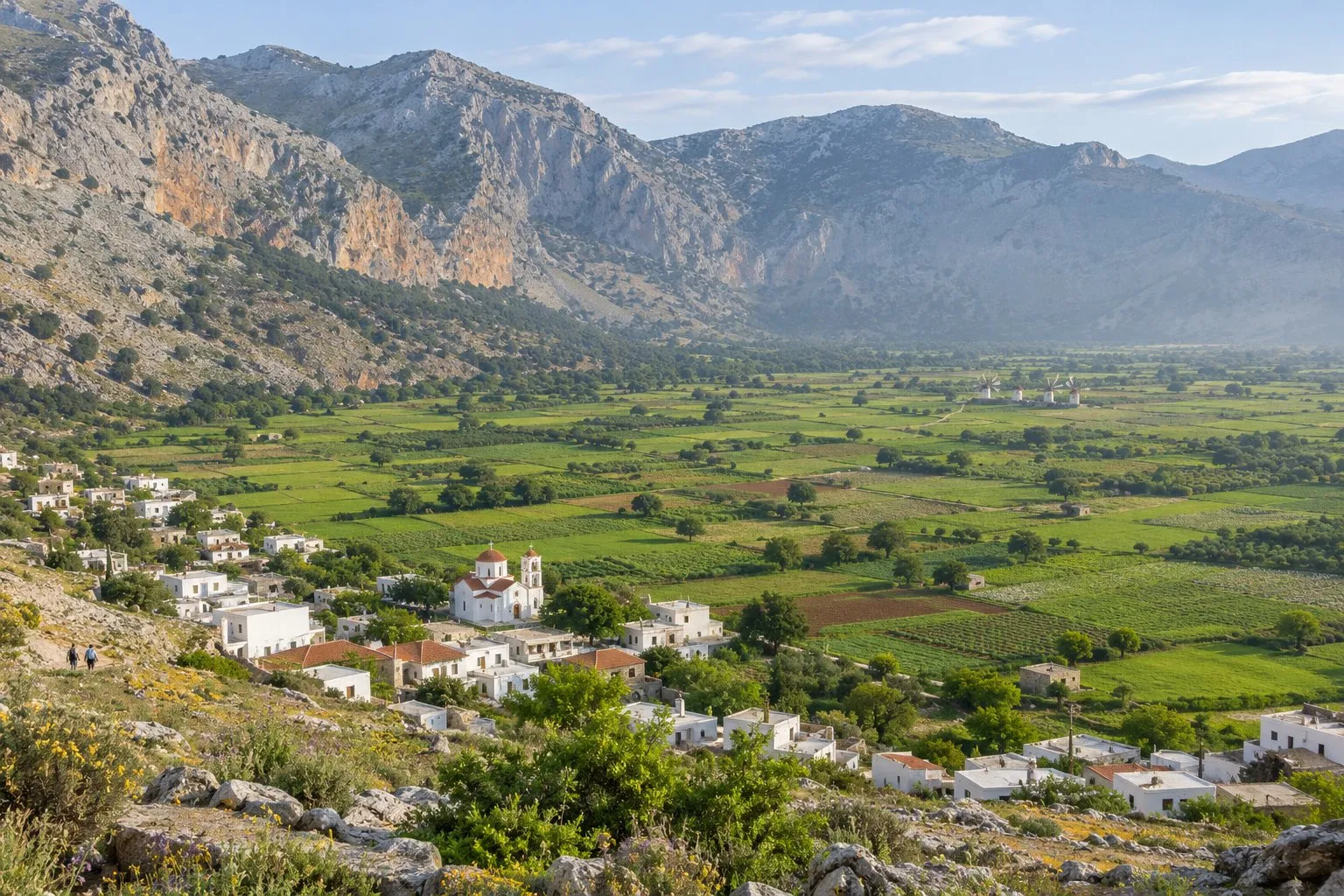
An hour from the coast, the Lasithi Plateau is another Crete: a completely flat farming plain at about 800-850 metres above sea level, ringed by the mountains of the Dikti massif. It measures about 11 km from east to west and about 6 from north to south, and it is planted mostly with potatoes, vegetables and fruit trees. It shares its name with the regional unit that Agios Nikolaos belongs to, but the two shouldn’t be confused: here we’re talking about the plateau.
It’s an ideal excursion for a day when you fancy something different from the beach, and the best-known stop is the Cave of Zeus (Dikteon Cave), in Psychro, which mythology names as the birthplace of Zeus.
Getting there from Agios Nikolaos
From our pension, the Psychro cave is an hour away by car (about 45 km). There are two main paved roads up to the plateau:
- From the east, on the Agios Nikolaos side: head towards Neapoli and from there climb through the interior, passing mountain villages such as Exo Potami and Mesa Potami, until you enter the plain.
- From the north, from the Malia coast: the road climbs with many bends through the village of Krasi to the Seli Ambelou pass, at about 900 metres, where you first see the plateau.
A good idea is to make a loop: go up one way and come down the other, returning to Agios Nikolaos by the main north-coast road. If you’d rather not drive in the mountains, there are organised excursions that depart from the area.
These are mountain roads: narrow in places, with tight bends and sometimes animals on the road. Drive without hurrying, fill the tank before setting out and avoid coming back at night if you don’t know the way.
A plain of crops ringed by mountains
The plateau has been inhabited since the Neolithic. In the 13th century, during Venetian rule and after several revolts, the Venetians expelled its inhabitants and banned cultivation for about two centuries. Later they allowed the land to be worked again and laid out a network of drainage canals that still marks the grid of the fields. Centuries later, during the revolts against the Ottomans and in the occupation of the Second World War, the surrounding mountains served as a refuge.
The villages, about 17 or 18 of them, are not on the plain but on its edge, at the foot of the mountains, to leave the fertile land free and stay safe from the meltwater floods. A road of about 20-25 km circles the plateau and links them, so it’s easy to explore at a relaxed pace and stop wherever you like:
- Tzermiado, the largest village.
- Agios Georgios, the second, with a few small museums, including one of folk traditions (check whether it’s open before you go).
- Psychro, the starting point for the Dikteon Cave.
The road around the plateau is fairly flat, and between villages you see vegetable plots, fruit trees and country lanes.
The windmills
Lasithi is famous for its windmills, though it’s best to arrive with realistic expectations. There are two types:
- The stone mills of the Seli Ambelou pass, at the northern entrance, which were used for grinding grain. Most are in ruins and some have been restored.
- The pumping windmills, metal structures with white cloth sails that drew water from the subsoil for irrigation. They spread between the late 19th century and the first half of the 20th, and there were once thousands of them (often said to be around 10,000).
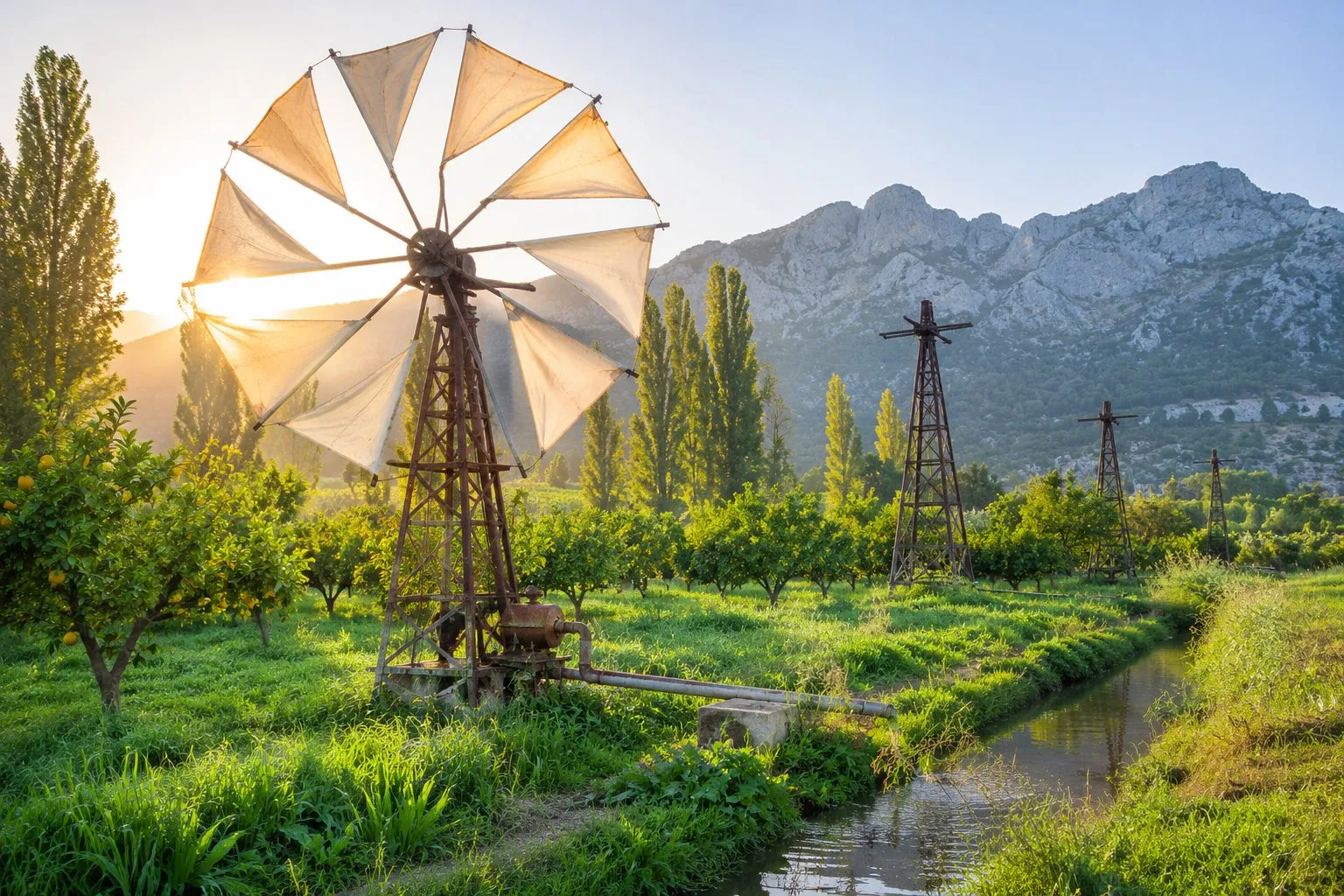
Today most of the pumping windmills are abandoned, replaced by motor pumps. You’ll see many structures without sails scattered across the fields and only a few working or restored. Even so, the landscape is still very photogenic, especially first thing in the morning or at the end of the afternoon.
The Dikteon Cave, the “Cave of Zeus”
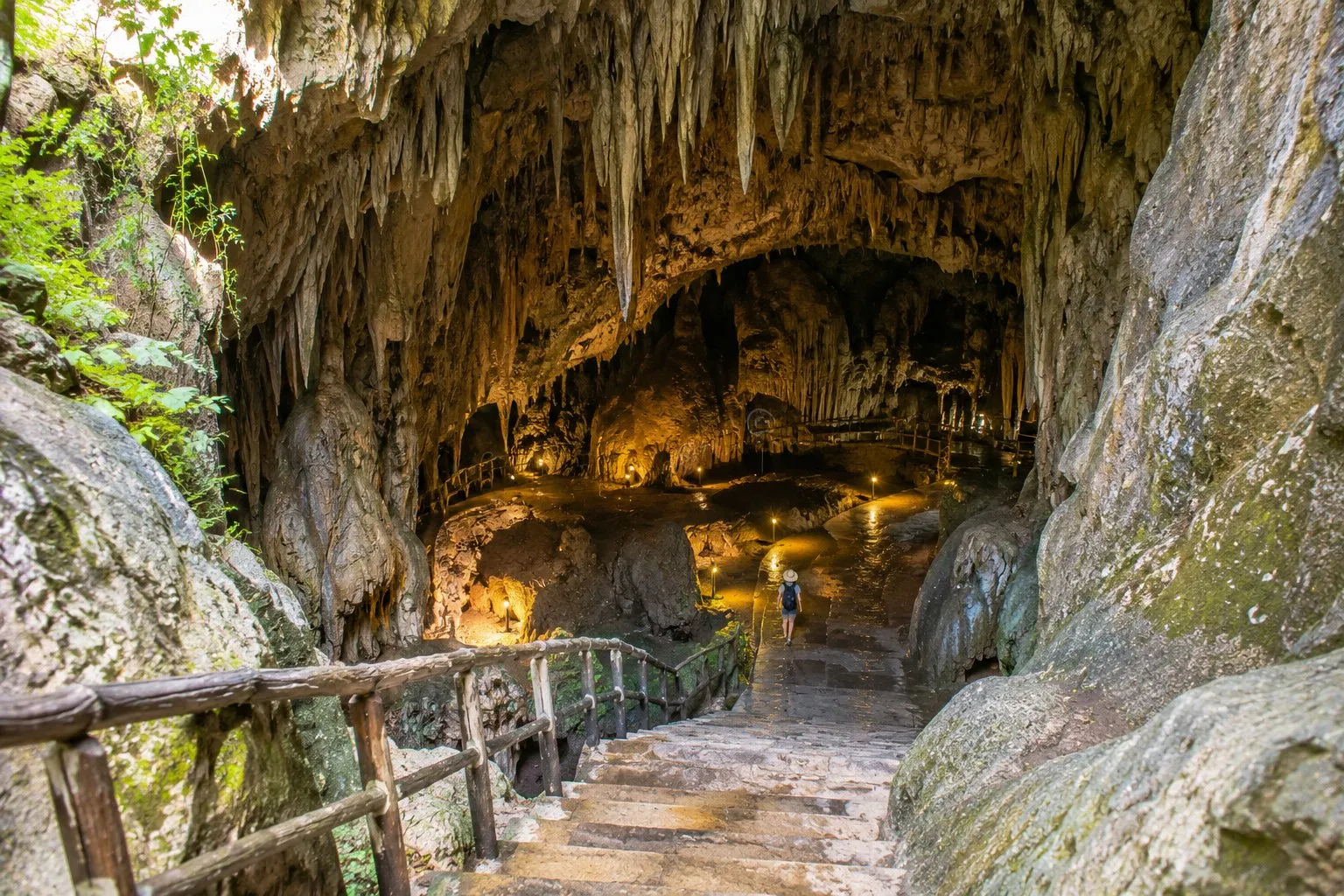
According to Greek mythology, Rhea hid in a cave in Crete to give birth to Zeus and save him from his father, Cronus, who devoured his children. Tradition identifies that cave with the Dikteon, above the village of Psychro, although another tradition places the episode in the cave on Mount Ida. Myth aside, archaeology does confirm that it was a place of worship from Minoan times: numerous offerings were found there, many of them now displayed in the Heraklion Archaeological Museum, which you can combine with a visit to the Palace of Knossos.
What the visit is like
- From the car park at Psychro you have to walk up about 800 metres on a steep slope, 15 to 20 minutes depending on your pace.
- Inside the cave you go down steps to the bottom, among stalactites and stalagmites, and then you have to climb back up them. The floor can be damp and slippery: wear shoes with a good sole.
- It is not a suitable visit for people with reduced mobility.
- The cave was closed for about two years for consolidation and improvement works, and reopened in 2026. Check the opening hours and the state of the visit before setting out, because they change with the season.
Tips for the day
- Bring something warm. It’s cooler on the plateau than on the coast, even in summer. In winter it can be properly cold, and snow sometimes lingers on the mountains, and even on the plain, well into spring.
- Set off early to reach the cave before the organised groups.
- Have lunch in one of the plateau’s villages. It’s a farming area and mountain cooking has its own character; in what to eat in Crete we give some pointers on dishes worth trying.
- Allow the whole day. Between the drive, the cave, the return to the plain and lunch, the whole day goes easily.
If you’re looking for something shorter, in half-day driving routes we suggest routes of a few hours near Agios Nikolaos, and if you’re planning several days in the area, you’ll find ideas in a week in eastern Crete.
In short: set aside a whole day, set off early, bring a warm layer and comfortable shoes, and check the state of the cave the day before. With that, Lasithi is one of the most pleasant excursions for getting to know the island’s interior.