The Palace of Knossos: an excursion to discover Minoan Crete
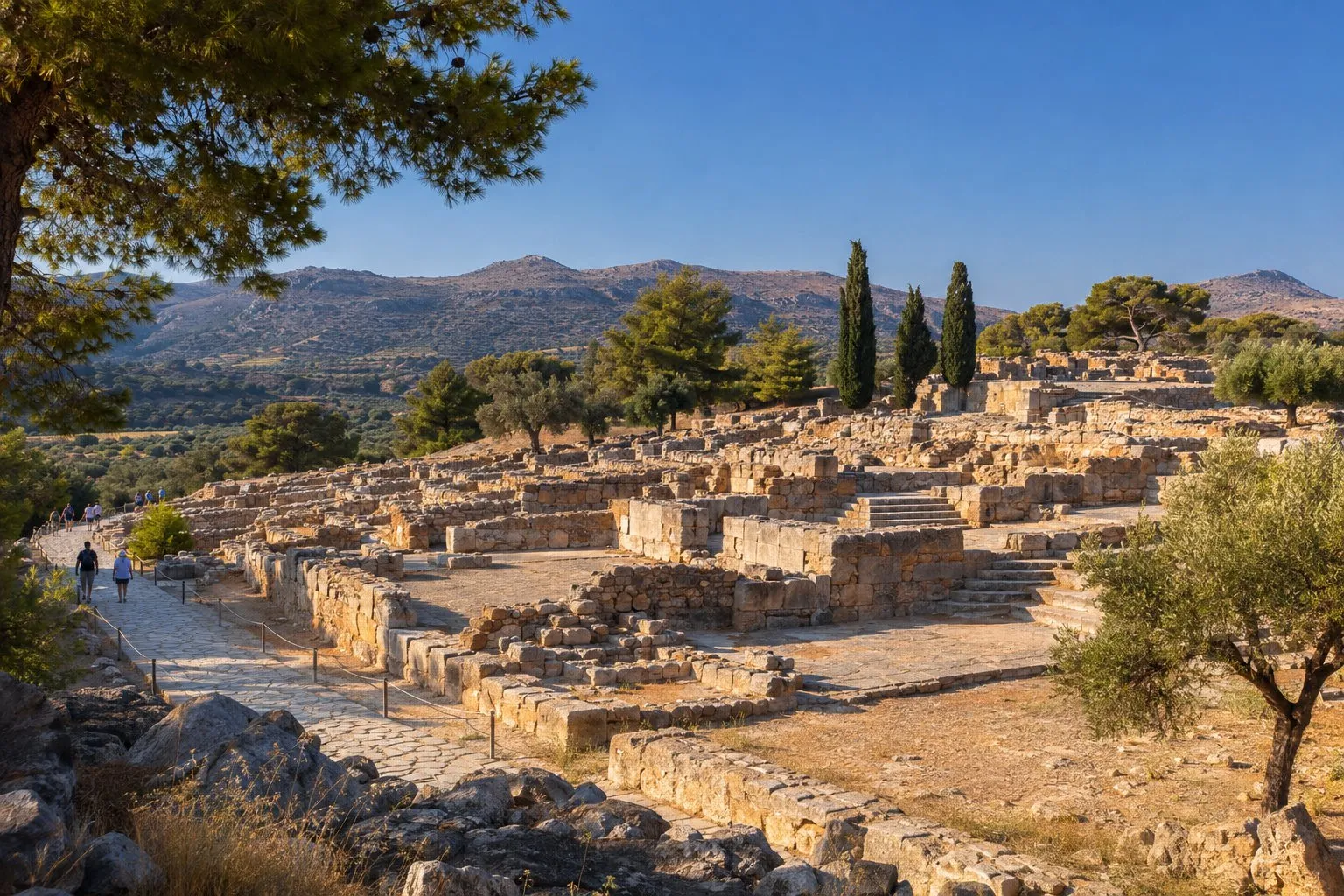
Knossos is the best-known archaeological site in Crete and the great centre of Minoan civilisation. From our pension in Agios Nikolaos it is an hour away by car (65 km), on the outskirts of Heraklion. It’s a full-day excursion that makes more sense if you combine it with the Heraklion Archaeological Museum, where the original finds are kept.
What Knossos was
The hill of Knossos was inhabited from the Neolithic, some 9,000 years ago. The first palace was built around 1900 BC; it was destroyed and rebuilt, and what you visit today corresponds mostly to its period of greatest splendour, about 3,500 years ago. The date and cause of its final destruction, around the 14th century BC, are still debated.
It’s best not to imagine it simply as a king’s residence. It was a political, economic and religious centre, with storerooms, workshops, areas of worship and reception rooms around a great central courtyard. In 2025, UNESCO inscribed Knossos on the World Heritage List together with other Minoan palace centres in Crete, such as Phaistos, Malia and Zakros.
Myth and archaeology
The name “Minoan” comes from King Minos of Greek mythology. According to the legend, Daedalus built for him the labyrinth where the Minotaur lived, which Theseus eventually killed. It’s an ancient and very appealing tale, but it is just that, a legend: archaeology has found no labyrinth. What there is is an enormous building, with many levels and corridors, which helps explain why the myth became attached to this place.
Evans’s reconstructions
The British archaeologist Arthur Evans began excavating Knossos in 1900 and worked there for about thirty years. As well as excavating, he reconstructed parts of the palace, mainly from the 1920s onwards and using reinforced concrete: the well-known red columns, some upper floors and walls with painted copies of the frescoes.
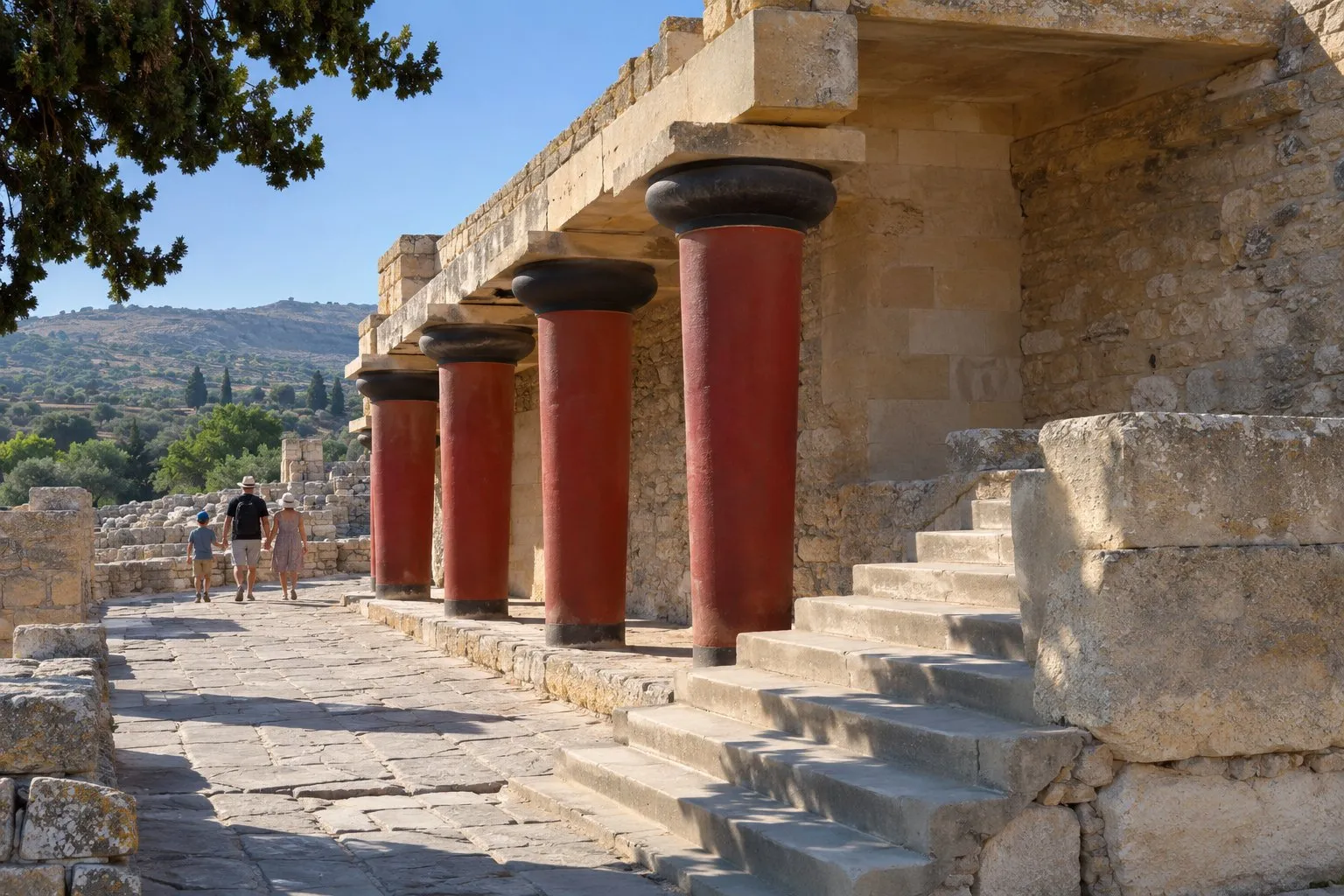
These reconstructions help give an idea of the building’s volume, but they are an interpretation by Evans and his team, not an exact portrait of how it looked. Many archaeologists have criticised them and today they are considered part of the site’s own history. For your visit, the important thing to know is that the frescoes you’ll see at Knossos are reproductions: the original fragments are in the Heraklion museum.
What to see on the tour
The site is large and is not signposted like a museum, so it helps to go with a few clear stops in mind:
- The central courtyard, the great open space around which the palace was organised.
- The throne room, with its stone seat and the griffins painted on the walls (reproduction). Sometimes it can only be seen from the entrance.
- The storerooms of the west wing, with rows of large pottery jars (pithoi) where oil, wine or grain were kept.
- The grand staircase of the east wing and the area Evans called the “royal apartments”, with the copy of the dolphin fresco.
- The north entrance, with the reproduction of the bull relief, one of the most photographed images on the site.
For an unhurried visit, allow between an hour and a half and two and a half hours, depending on your interest and the heat.
The Heraklion Archaeological Museum
The museum is in the centre of Heraklion, a few kilometres from Knossos, and holds the most important Minoan collection in the world. Here you’ll find the original Knossos frescoes (such as the bull-leapers or the so-called Prince of the Lilies), the figurines of the snake goddess, the bull’s-head rhyton and the Phaistos Disc, among many other pieces.
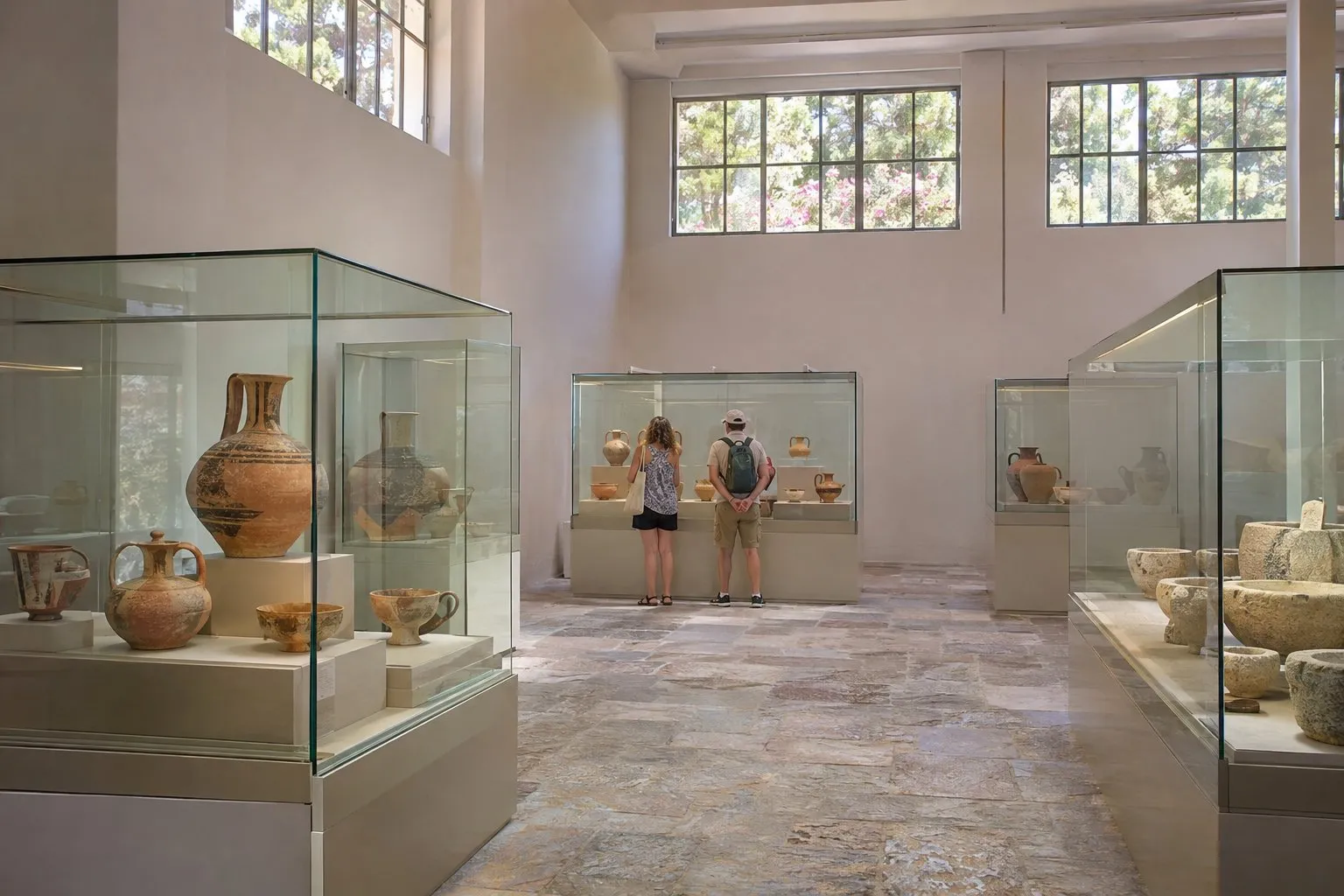
Seeing the site without the museum leaves the visit half done. Some people prefer to start with the museum to understand better what they’ll see afterwards, and others prefer to do it the other way round. Doing both in the same day is possible, although it makes for a long day: if you’re travelling with children or in midsummer, you may prefer to leave the museum for another day. It’s also a good plan for a rainy day, as we explain in what to do in Agios Nikolaos when it rains.
Practical tips
- Go early. Knossos has very little shade and in summer the heat builds from mid-morning, which is also when more groups arrive. Late in the afternoon there are usually fewer people.
- Protect yourself from the sun: water, a hat and sun cream, even in spring and autumn.
- Comfortable footwear. There are steps, uneven stone and slippery areas.
- Guided tour or audio guide. Without explanations it’s easy to get lost among walls and levels. Guided tours are usually offered at the entrance, and there are also audio guides and apps.
- Check hours and tickets before you set off. They change with the season and, on days of extreme heat, the authorities may limit the opening hours of open-air sites. It’s best to check on the official ticketing website or at the site itself.
- Spring and autumn are the most comfortable times for the visit.
Fitting it into your trip
By car, the journey from Agios Nikolaos follows the main north-coast road almost all the way. On the way you’ll pass near Malia, where there is another Minoan palace, smaller and usually quieter, in case you’re left wanting more.
As Heraklion airport is 50 minutes from the pension (62 km), Knossos and the museum also fit well on your arrival day or departure day, if your flight allows. We explain it in how to get here from Heraklion airport. If you don’t have a car, you can take the intercity bus to Heraklion and from there the city bus to Knossos; we give more details in getting around without a car.
If you’re interested in the interior of the island, another excursion that combines scenery and mythology is the Lasithi Plateau, with the cave that tradition associates with the birth of Zeus.
To organise the day, our advice is simple: leave Agios Nikolaos early, visit Knossos before the heat builds, have lunch in Heraklion and spend the afternoon at the museum. Bring water and check opening hours the day before, and you’ll come back with a much clearer idea of who the Minoans were.